Wine Tasting Basics
How to Taste Wine With More Confidence (and More Enjoyment) 🍷
There’s a funny thing that happens when people begin learning about wine.
At first, tasting can feel intimidating.
Someone swirls a glass, pauses thoughtfully, then announces they detect wild strawberry, cedar box, wet river stone, and a hint of grandmother’s spice cabinet.
Meanwhile, you’re thinking:
> “I taste… wine.”
That’s perfectly fine.
Because here’s something worth remembering from the start:
There are no right or wrong answers in wine tasting.
The purpose of tasting isn’t to impress anyone.
It isn’t about memorizing descriptors.
And it certainly isn’t about proving your palate.
The purpose of tasting is simple:
To discover what you enjoy.
Every glass teaches you something.
The more you taste, the more patterns emerge.
You begin noticing:
✅ Wines with bright acidity appeal to you
✅ Maybe earthy Pinot Noir excites you more than fruit-forward styles
✅ Perhaps richer Chardonnay is your comfort zone
✅ Or maybe you discover your favorite wine comes from a region you’d never considered
Wine tasting is less about evaluation…
…and more about exploration.
Let’s break down the basics.
Step 1: See
What Does the Wine Tell You Before the First Sip?
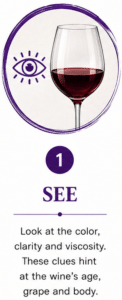
Before smelling or tasting, spend a moment simply looking.
Hold the glass against a light background and observe:
👀 Look for:
✓ Color intensity
Is it pale or deep?
✓ Clarity
Bright and clear? Slightly hazy?
✓ Hue
Young reds may lean purple, while older wines become brick or garnet.
Whites often deepen from pale straw toward gold as they age.
✓ Viscosity (“legs”)
Swirl gently and watch droplets run down the glass.
More pronounced legs can suggest higher alcohol or richness.
None of these observations determines quality.
They simply offer clues.
Think of it as reading the first chapter before the story unfolds.
Step 2: Swirl
Why We Do It
Swirling wine isn’t just something people do to look experienced.
(Though it certainly appears dramatic.)
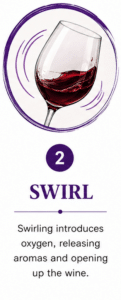
➡️ Swirling introduces oxygen and helps release aromatic compounds trapped in the wine.
In simple terms:
Swirling helps wine reveal more of itself.
Try this:
→ Smell immediately after pouring.
→ Then swirl.
→ Smell again.
Notice the difference.
→ Often the wine becomes more expressive.
→ Fruit may emerge.
→ Floral notes appear.
→ Earthiness surfaces.
The story becomes clearer.
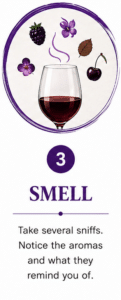
Step 3: Smell
The Nose Often Reveals More Than Taste
Believe it or not, much of what we interpret as flavor begins with aroma.
Take several short smells.
Then ask yourself:
What comes to mind?
Fruit?
Cherry?
Blackberry?
Apple?
Citrus?
➡️ Floral?
Rose?
Lavender?
Violet?
➡️ Earth?
Forest floor?
Mineral?
Mushroom?
➡️ Oak & Spice?
Vanilla?
Cedar?
Clove?
Again:
There are no wrong answers.
Your experiences shape what you notice.
One person says blackberry.
Another says plum.
Someone else remembers childhood jam.
All valid.
Wine often connects to memory.
Step 4: Taste
Let the Wine Move Across Your Palate
Take a sip.
Don’t rush.
Let the wine move.
Then consider:
✅ Fruit
What flavors stand out?
Dark berries?
Stone fruit?
Citrus?
Tropical fruit?
---
✅ Acidity
Does the wine feel fresh and lively?
Do you notice your mouth watering?
Higher acidity often brings energy.
---
✅ Tannins (mostly reds)
Do you feel grip or dryness?
Young Cabernet Sauvignon often has more tannic structure than Pinot Noir.
---
✅ Body
How heavy or light does the wine feel?
Think:
Skim milk → Whole milk → Cream
Wine has similar weight differences.
---
✅ Texture / Mouthfeel
Silky?
Creamy?
Velvety?
Sharp?
Broad?
Texture can become one of your favorite things to identify over time.
Step 5: Evaluate the Finish
What Happens After You Swallow?
This part gets overlooked.
It shouldn’t.
Ask:
➡️ How long does the flavor remain?
A few seconds?
Thirty seconds?
Longer?
➡️ Sometimes exceptional wines continue unfolding long after the sip ends.
That lingering impression is called:
The finish.
Length alone doesn’t guarantee quality.
But memorable wines often leave memorable finishes.
Step 6: Why Decanting Matters
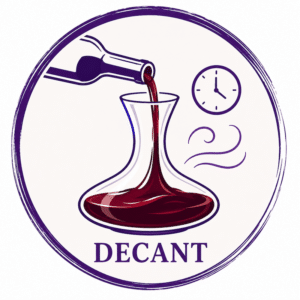
Giving Wine Time to Breathe
You’ve probably heard:
> “This wine needs to breathe.”
What does that actually mean?
When exposed to oxygen, wine begins changing.
➡️ Decanting can:
✅ Help soften tannins
Young red wines often become more approachable.
✅ Release aromas
Fruit and complexity emerge more clearly.
✅ Improve texture
Some wines feel more open and balanced after breathing.
✅ Separate sediment
Older wines occasionally throw sediment as they age.
Decanting helps keep it out of your glass.
---
➡️ How Long Should You Decant?
General guidelines:
✓ Young Cabernet / Syrah / Bordeaux blends:
30–90+ minutes
✓ Older wines:
Shorter periods (or none) depending on fragility
✓ Light reds or whites:
Often unnecessary, though experimentation is encouraged
The best approach?
Taste before decanting.
Taste after.
See what changes.
That’s education.
Wine Tasting Is About Discovery, Not Perfection
The goal isn’t becoming someone who identifies 47 aroma descriptors.
The goal is much more simple:
Finding wines that make you pause…
Pour another glass…
Share with friends…
Create memories.
Because wine education isn’t about knowing everything.
It’s about discovering what you love.
So next time you open a bottle:
➡️ See.
➡️ Swirl.
➡️ Smell.
➡️ Taste.
➡️ Evaluate.
Then ask yourself:
> Would I happily drink this again?
That answer matters more than any tasting note.